I gave ChatGPT the full context of my business and website, then created two Scheduled automations. The first prepares a researched monthly SEO and GEO content plan. After I approve it, the second runs daily at 11:30, writes the next approved article in my website's design system, validates it and publishes it through Sites.
Why I built a two-stage system
Writing a blog post is only one part of useful publishing. The real work starts earlier: understanding the audience, choosing a question worth answering, avoiding duplication, finding credible evidence and connecting the article to a wider topic cluster.
Putting all of that into one daily instruction would make the system harder to review and easier to derail. I therefore split it into planning and publishing, with a human approval gate between them.
Automation should remove repeated execution—not remove editorial judgment.
The context I gave ChatGPT first
The quality of recurring work depends on the quality of its standing context. Before scheduling anything, I explained what I do, who I serve, the markets I operate in, the problems my audience faces, my offers, my point of view and how I want to sound.
- Business: services, positioning, expertise and commercial priorities.
- Audience: roles, industries, company stage, geography and recurring questions.
- Brand: tone, principles, claims I can support and language I avoid.
- Website: existing pages, content archive, calls to action, internal-link opportunities and visual conventions.
- Evidence: firsthand experience, case patterns, trusted sources and subjects that require verification.
What SEO and GEO mean in this workflow
Search engine optimisation (SEO) helps a useful page become understandable and discoverable in conventional search. I focus on the reader's intent, topic coverage, descriptive structure, internal links, metadata and avoiding overlap with existing pages.
Generative engine optimisation (GEO) makes the same knowledge easier for AI answer systems to interpret and reference. In practice, that means answering the core question early, defining terms clearly, using factual and self-contained passages, naming relevant entities, showing real experience and citing trustworthy sources. It is not a separate excuse to write for machines; it is a discipline for making expert information easier to understand.
Automation 1: the monthly research and content plan
This automation runs once a month. It reviews the website and the context I supplied, researches audience questions and opportunities, then proposes a connected calendar. Crucially, it is instructed to stop at the plan. Nothing is published before I review it.
Copy-and-customise planning prompt
You are my SEO and GEO content strategist. Once a month, research and prepare the next month's blog plan for [WEBSITE / BUSINESS].

BUSINESS CONTEXT
- Business: [WHAT YOU DO]
- Audience: [WHO YOU HELP, INDUSTRY, LOCATION, BUSINESS STAGE]
- Services/products: [LIST]
- Brand point of view: [YOUR DISTINCT BELIEFS OR METHOD]
- Website: [URL]
- Existing content: Review the site's current pages and blog archive. Do not duplicate them.
- Geography/language: [MARKET AND LANGUAGE]

GOAL
Build topical authority and attract qualified readers through:
1. SEO: relevant search intent, helpful keyword coverage and internal linking.
2. GEO: clear, factual, self-contained answers that AI search and answer engines can understand and cite.

RESEARCH TASKS
1. Identify the audience's recurring questions, problems and decision points.
2. Find a balanced mix of commercial, informational and comparison intent.
3. Map one primary topic cluster and supporting subtopics.
4. Look for content gaps in the existing site and credible sources worth citing.
5. Prioritise useful original insight over keyword volume alone.

DELIVERABLE
Create a calendar for [NUMBER] articles. For every article include:
- proposed publish date
- working title and URL slug
- primary search intent
- primary topic and supporting phrases/entities
- the exact question answered in the opening
- GEO-ready answer summary in 2–3 sentences
- recommended H2 outline
- firsthand insight, example or proof I should add
- internal links to existing pages
- external sources to verify or cite
- call to action
- status: AWAITING APPROVAL

Finish with:
- the month's topic-cluster map
- duplication or cannibalisation risks
- the five strongest priorities and why
- questions or missing context you need from me

IMPORTANT
Do not write or publish any article in this task. Stop after presenting the plan and wait for my approval.
My approval checkpoint
I review the proposed titles, search intent, topic clusters and internal links as one portfolio. I remove weak ideas, merge overlapping ones and add the insight that only I can provide. The publishing automation can act only on rows explicitly marked APPROVED.
Accuracy
Can I support the claims, examples and point of view?
Usefulness
Does this solve a real audience question better than a generic summary?
Fit
Does it strengthen my expertise and connect naturally to my services?
Automation 2: write and publish every day at 11:30
The second Scheduled automation is the execution layer. At 11:30 each day, it finds that day's approved item, inspects the current site, writes the article, reuses the existing design, updates the content listing and search-discovery files, validates the result, and publishes it. If the item is unapproved, missing or already live, the safe outcome is to stop and report—not improvise.
Copy-and-customise publishing prompt
You are my daily blog writer and site publisher. Run every day at 11:30 in [TIMEZONE].

SOURCE OF TRUTH
- Website: [URL]
- Approved content plan: [LINK OR LOCATION OF APPROVED PLAN]
- Brand context: [VOICE, AUDIENCE, EXPERTISE, OFFERS, LOCATION]

PRE-PUBLISH CHECK
1. Find today's item in the approved plan.
2. Continue only when its status is APPROVED.
3. Inspect the live site, its existing articles, navigation, visual system and technical structure.
4. If today's item is missing, unapproved or already published, do not publish. Report the reason instead.

WRITE THE ARTICLE
- Match my voice: [VOICE DESCRIPTION].
- Answer the main question clearly near the beginning.
- Write for a person first; use natural language, not keyword stuffing.
- Use a descriptive title, URL, headings and metadata aligned with search intent.
- Make important explanations self-contained and easy to quote accurately.
- Add relevant entities, definitions, examples and FAQs only where useful.
- Include firsthand experience or a clearly marked placeholder when only I can supply it.
- Link to relevant pages on my site and to authoritative sources for factual claims.
- Never invent statistics, quotes, customers, results or sources.
- Do not repeat or compete with an existing article.

PUBLISH WITH SITES
1. Create the article inside the existing website project.
2. Reuse the site's current components, typography, spacing, colours and mobile behaviour.
3. Add the article to the blog/knowledge listing, sitemap and other discovery files used by the site.
4. Add Article structured data and accurate canonical/social metadata.
5. Check links, readability, responsive layout and the production build.
6. Publish the verified version through Sites.

FINAL REPORT
Return the live URL, title, target intent, internal links added, sources used, and any issue that needs my attention. If publishing fails, do not hide it or create a partial duplicate; report exactly where the run stopped.
Where Sites fits
Sites is the ChatGPT website-building and hosting surface I use for this website. The site is stored as a real web project, and ChatGPT can work with its pages, components and assets, check that the site builds correctly, then save and publish a new version. Because the website already lives there, the publishing automation can update the actual design system instead of pasting disconnected text into a separate CMS.
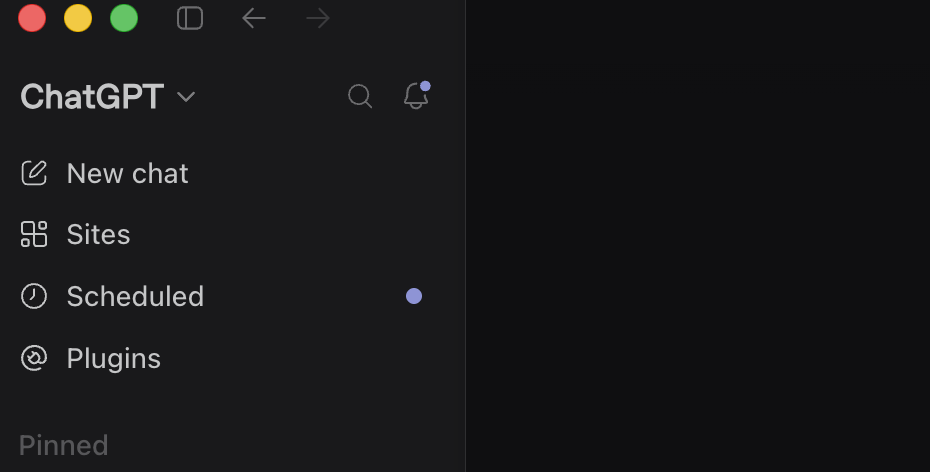
In the ChatGPT sidebar, Sites is where the website lives and Scheduled is where the recurring planning and publishing work is configured. Availability and the exact interface can vary by account or workspace.
How to set up the two Scheduled automations
- Open Scheduled in ChatGPT and create a new recurring task.
- Name the first task “Monthly SEO + GEO content plan,” paste the planning prompt and choose a monthly schedule.
- Run it once, correct any missing context, and decide where the approved plan will live.
- Create a second task called “Daily approved blog publisher,” paste the publishing prompt and set it to 11:30 in your timezone.
- Point the prompt to the correct site and approved plan, then test one approved article before relying on the daily schedule.
- Review the first few runs closely. Tighten the prompt whenever you notice a repeated decision that should become a rule.
Guardrails I would not remove
- Never publish an idea that has not been explicitly approved.
- Never invent a statistic, quotation, source, customer story or result.
- Never create a new design when the website already has a working design system.
- Never publish a duplicate just because today's scheduled item is missing.
- Always return the live URL and a short publishing report.
- Periodically review performance and refresh the strategy; a schedule is not a substitute for learning.
What this changed for me
The system removed the blank-page problem and the repeated mechanics of publishing. I still decide what deserves to carry my name. ChatGPT handles the recurring research, drafting and site work around that decision, while the approval gate keeps the content connected to my real experience and business priorities.
Start with the system
Automate the repeatable work. Keep ownership of the judgment.
Use the two templates above, replace every bracketed field, and test the full loop with one article before turning on a daily schedule.
Explore more practical guides →